
Nope, networking is not connecting your computer to a network (to the guy who looked at me strangely after I told him I went to ‘networking events’).
If you’ve never been to a networking event let me explain a bit how they usually work: a company/organisation/person organises an event in a small or large room (depending on how many people are expected). Sometimes there’s food and drinks, sometimes you need to wear a badge with your name on it and sometimes it’s very chill and it’s happening at a bar.
People arrive at the designated place, walk around, pick on a bit of food and… start talking. Yep, that’s what adults do nowadays.
But it can get pretty interesting; there’s often a speaker who comes up half an hour later to talk about a cool startup they’re working on or some nice advice for the newbies. People think, ask questions, and then continue talking to each other. Doesn’t sound very exciting? We’ll get onto that in a minute.
Networking is essentially how adults get to meet new and interesting people: exchanging business information with other professionals. But the thing that makes it different to simply throwing a bunch of strangers in the same room is the fact that all these people came because they wanted to. Many times someone comes with a business idea, or is looking for business ideas. Maybe they are looking for a co-founder, or someone to help them out with a project. They come here seeking opportunities and new contacts, and it’s that attitude that can make networking events quite inspiring and worth your time.
Why should I network in university?
University is an amazing place to make friends. You’re all thrown into this kind of bigger version of high school and you all are hoping to leave it with a degree and a bright future. It’s those years in the middle including crazy parties, strange lecturers and nights before exams that makes you bond with the other students around you. These will be friends for life, friends with whom you can talk about anything and do anything, and that makes them very special.
But here I’m not talking about making friends, I’m talking about making professional friends: people who could actively help you with your ideas, questions and thoughts. People who want to hear your ambitions and give you advice, people who might take it themselves.
By meeting these different kinds of people you are forcing yourself out of your comfort zone: getting out of your usual group means you get to see a different perspective to the issue you’re working on. Not only that, but many networking events have people from all backgrounds: startup founders, business professionals, gurus who’ve done it all, etc. These events are a mixture of different talents, all of them with a person who has something to say.
As a student, this can be great. Even if you’re not working on your next business idea, networking is a great place to seek opportunities: someone looking to hire an intern, someone looking to collab or simply someone who has an interesting thought. And since in university we’re young and we’re learning, why not fill that sponge up a bit more and learn some more.
Think of the well-known quote: ‘it’s not what you know, but who you know’. These events are a great place to work on the ‘who you know’ part. And it’s not about just making contacts, it truly is about making friends. The key to networking effectively is turning those contacts into friends; building trust-based relationships and learning how to work together. More on that below.

How to become a pro
So now you’re convinced that you need to start networking. Where to get started?
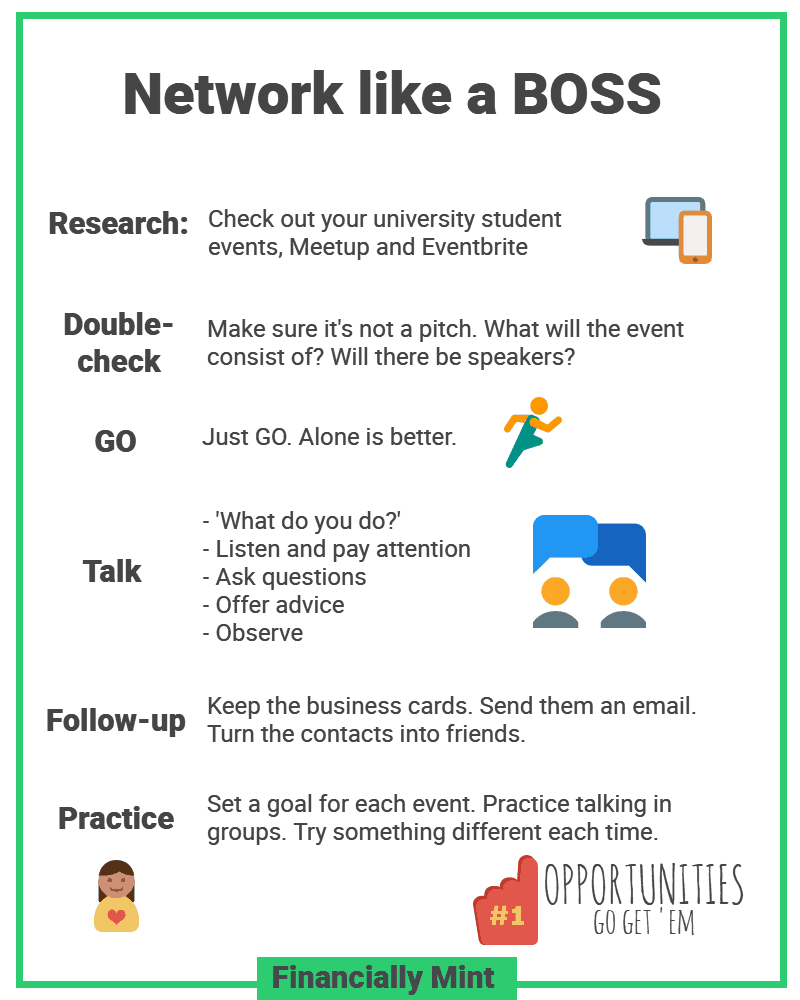
1. Research
Does your university offer networking events? Are there any opportunities or events where ‘professionals’ get together and talk? This could be with keynote speaker or a workshop. Either way, that’s a networking event.
If not, turn to the outside world. Eventbrite and Meetup are my go-to to find networking events and cool conferences. I check them once a week and register ahead of time if there’s one that intrigues me. Usually if they have the term ‘networking’ in them, it means it’s a networking event (surprising I know).
2. Make sure it’s not a pitch
Advice from someone with networking experience: you don’t want to be wasting your time. What do I mean by a pitch? Basically a company that starts off with a nice inspiring talk and finishes off trying to sell you something. Many times there’s no networking at all. Be especially careful with MLM pitches: they try to convince you that you’re starting your own business when actually you’re doing all the work and getting 20% of the profits.
Here are a few signs it’s a pitch:
- Someone invited you to the event, telling you this is a very exciting opportunity
- But for some reason they never say the name of the company or what the talk is about
- The presentation is all about how amazing the organisation is and the actual product is mentioned briefly at the end
- They won’t stop saying ‘this is a great opportunity’
- It’s purely profit based - they don’t actually care whether the product is vegan, environmentally friendly or farts rainbows, they just want you to buy and pitch others.
3. GO
Doesn’t matter if you’re alone, just go. Actually going alone is even better: you really have to force yourself to talk to others and get out of your comfort zone. I know it’s nerve racking: there’s tons of strangers around and YOU have to go talk to them! How does that even work? Practice my friend, practice.
4. Talk
Assess the room around you: is there anyone standing on their own? Go talk to them. If there isn’t, join a random group and be like ‘Can I join you guys?’. Relax and get to know the people around you. Many will be in the same position: trying to make conversation with complete strangers. After the initial introduction comes the usual question ‘So what do you do?’. There you can awe them away with the fact that you’re a university student and you’re here to meet interesting people. Then ask them the same question. Ta-da, conversation.
The important part here is to show that you’re human: ask questions, pay attention, offer advice. Make a connection with them, show them that you have a lot to offer and are willing to learn. Once you prove them that you’re willing to collaborate, then the opportunities will come.
As the conversation evolves more questions and interesting issues will come to mind and you might find a golden nugget. If it starts getting awkward or boring, simply say you’re off ‘to get some tea/beer/coffee’ and move onto the next person (preferably after getting your beverage). And that’s it. The key to networking well is to be relaxed and not take it too seriously: you’re just here to observe, meet some interesting people and find opportunities.

5. Follow-up
As I said before, the secret to effective networking is turning your contacts into friends. How do you do this? By making sure to follow up. You’ll probably end up with a huge collection of business cards; keep them (you could always create a collage). Met someone who especially interested you? Send them an email asking how they’re doing. People love being noticed and remembered - by putting in the initial effort you show that you care.
6. Practice
The first few events may be awkward and you may be nervous. But it really does get easier with practice.
At the beginning, all I could do was talk to one or two people at a time, and immediately go quiet if more people joined. Slowly and steadily, I gained confidence and was able to talk to a few people at once. Now I’m at the point where I can speak in pretty large groups about my ‘business idea’ AND look everyone in the eye (not easy). This means I get everyone’s full attention and concentration, and therefore more people have something interesting to add. And the weirdest part: I’m starting to enjoy it.
You don’t need to become a networking expert or a social butterfly who knows everyone and their business idea. You don’t have to be at every event and follow up on every business card you get. Go a few times a month, practice your social skills, meet interesting people and listen to their ideas. You never know what the next one could bring - an internship? A job? A business partner? A generous millionaire? You won’t know until you GO.

